Karma’s a B—h

Recently I’ve been reading a book called Karma and Reincarnation, by Dr. Hiroshi Motoyama. (He’s the teacher that created a lot of the Spiritual Healing work I’ve been studying under Dr. Richard Jelusich.) I thought I knew a few things about karma, but I am learning a ton.

I also read this great blog about the spiritual shift that is happening in our world today. A lot of us are being called to release the negative attachments we have (karma), and do it now, so that we can collectively move toward a more peaceful, positive society.

I would have been content to read about these things and consider them philosophically. The Universe, however, is more concerned with getting things done.

A few days ago, someone tried to post a troll on my blog. (A troll is a comment that is often insulting and egotistical, with no real relevance to the topic, posted with the intention of attracting other frivolous remarks and attention.)

I don’t believe in censorship, so I actually considered publishing it. However, I also don’t publish spam or hate mail, so I ended up deleting it. I assumed that he was just a kid who was surfing the net leaving rude remarks on people’s blogs and never coming back.

Oddly enough, the troll came back. Of course he did. I had a karmic connection to him at this point. (And who knows, maybe it goes back to a previous lifetime. Maybe I scrawled some awful graffiti on the wall of his hut a thousand years ago.)

Karmic connections result not only from what we do to (or for) others, but also from the emotional and mental attachments around them. It is possible that I attracted this guy into my life because I still have issues with bullies and insults that I have not entirely forgiven or released. In other words, the karma might be a general issue in my life, and nothing to do with him personally.

His next comment was about how I’m a hypocrite for preaching non-judgement and forgiveness, and then judging him and deleting his comments. (That comment isn’t being published either.) Now, maybe I’m creating more karma by paying attention to it instead of just deleting it and moving on, but I would actually like to learn from this.

If I do not deal with the negative attachments I have to the issues here – if I do not release the karma and move on – I will keep attracting him and people like him into my life.

If I try to defend myself by attacking him in return, I will create more bad karma. (Not to mention, enable the negative behavior.) And if I delete his comments and call him bad names in my head, I will create more bad karma.

If I forgive him and treat him with compassion… then who knows? Hopefully, good karma. What if I try to contact him and open up a civil conversation? Is it worth it? How do you talk to a troll? Is it better to forgive and forget, or reach out with compassion?

I know that if I talk to him before I forgive him, nothing good can come of it. If I talk to him from a place of compassion and forgiveness, then it’s partly up to him whether anything good will come of it. I cannot change the attitudes of another person, but I can open the door to good karma.

Common sense would dictate that I should not “feed the trolls” – in other words, ignore the inflammatory comments completely without a second thought. But common sense has not helped us evolve our souls beyond the karmic soup we currently find ourselves in. Spiritually, we are “still waking up,” and it’s fun to experiment with new ways of practicing compassion and forgiveness.

If you have any constructive and relevant comments, please feel free to leave them.

Posted in Ego, Law of Attraction | Leave a comment

How not to sell

Today a guy knocked on my door and offered to clean one of my carpets for me. No obligation to buy anything – he just wanted to show me how good a job he could do so I would recommend it to my friends. I thought that sounded nice. So I invited him in.

A few minutes later he brought his friend Petey over – another nice young fellow in coveralls who would do the actual dirty work of taking out those tough stains left by the previous owner. I figured I would go do some writing, and then have a look at the carpet when he was done, and then send him merrily on his way. If it was good, I would post it on facebook and my blog, giving Danny what he asked for.

Danny then clarified that they were not promoting a carpet cleaning service, but rather a carpet-cleaning product. What kind of “product” that was did not become clear until later. He was playing his cards carefully.

My lie detector went off when Danny asked me, “Have you heard of Bill Gates?”

Questions like that usually launch into a convoluted explanation of how I will become as rich as Bill Gates, or of how this company is not evil like Bill Gates, or some other wild stretch. In this case, he talked about how Bill Gates got sued for cornering the market, and how they do not want to be sued for cornering the market, so they can’t sell their product in stores because then they would automatically corner the market (because it’s so good) so they can only sell it to me today, and that’s it.

Obviously a complicated lie, but I let it slide. I just wanted the stains out.

After Danny left, Petey explained to me how this chance to clean my carpet would get him one step closer to a fabulous vacation in Hawaii. (Wow, sales organizations still use that tired old tactic?) I hope he wins it. He looked like he could use a vacation.

Petey then began unpacking the equipment. I noticed the KIRBY(tm) label on all the stuff. They hadn’t mentioned Kirby before. Probably for the same reason that nobody mentions Amway any more. I had a feeling that this was not going to end positively, but I could not figure out why. My efficient brain had simply filed the KIRBY name in the Amway file without any supporting documents. Must have been from a conversation I had 20 years ago.

He took some time to put a vacuum cleaner together. He wanted to be sure I could see how simple it was to do. I didn’t really care. I couldn’t see how a vacuum cleaner would get the stains out.

I listened to Petey as he struggled to remember the words and phrases they had taught him in Kirby school. I don’t think they had trained him very long. He later admitted he was pretty new to this. (I then remembered that the last guy who had demo’d a vacuum cleaner to me was also brand new. These guys sure don’t last long in the industry. Churn and burn.)

The trouble with learning lines is, it can come across as dishonest and manipulative. Those tactics may have worked back in 1960, but they don’t work today. Today we’re a bit smarter. We still want our carpets cleaned, but we’re smarter. The only thing canned speeches are good for is mocking them on comedy shows.

(Mmmm… canned peaches… ahhhh…) Sorry, where was I?

Ah yes. Petey did an excellent job of showing me how much dirt and dust the Kirby vacuum could suck out of my tired old carpet. Tons. I agreed with him that it was a great machine, and I would surely buy one if I could afford one. He asked me how much value I would put on the machine. I said about $500. He wrote the number down.

As we got through the first hour, I realized that he would not be working unsupervised. He needed me there to watch everything. This was (contrary to Danny’s assertions) a product demonstration. I then spent another hour as his audience. The prospect of getting a couple stains removed from my carpet receded into the distant future.

Petey continued on through his marathon of demonstrations of all the attachments. He talked about it as if I was the owner already (another great 80’s tactic). Did you know that a Kirby vacuum can also be used to wash your car and fertilize your lawn? It’s true. Petey showed me the attachments.

As we finished up Hour #2, I felt the need to come clean with the Kirby man. I needed him to understand that I was definitely not going to buy this product, and I did not have time for another hour or two of demonstrations. My understanding, when we started, was that this was going to be quick, and that the expectation was not for me to buy something, but to tell my friends about it. That’s what Danny had said. Danny’s soft-sell approach set me up to become confused and frustrated when the truth came out.

After I opened up to Petey, he called his boss, Mark, who came over a few minutes later. Mark was obviously more experienced in the Kirby culture. He didn’t struggle for lines to say. He was polite and professional.

I asked whether they could get a stain out for me, to see if it really worked the way Danny had said. When I mentioned that I had already used a steam cleaner on the carpet, Mark explained that the cleaner had set the stain, and that the Kirby product would not be able to get the stain out. Sorry. (At least he was honest… I think…)

I talked with Mark about my experience this afternoon: being led to believe that it was not a demonstration, and then finding myself standing around for a 3-hour demonstration. Being led to believe that they would be happy with recommendations to friends, and finding out they expected a sale. Being honest with them up front that there was no way I could afford anything right now, and having them waste their time on a demonstration that would not result in a sale.

We talked for a couple minutes. Mark made it clear then that the entire presentation was important – to build an emotional high more and more with each part of the presentation, ending with the carpet shampoo at the end as a reward for getting all the way through. And then, of course, the prospect’s unbridled enthusiasm culminating in a sale.

Mark was actually open about the methodology here. I credit him for that. He must have sensed that I could see right through the sales tactics. He didn’t even have to explain them, because it was fairly obvious what was going on.

It just didn’t work.

None of that works any more.

The 1980’s-style of emotional manipulation and carefully crafted phrases are getting tired. We have seen them all before. Instead of responding the way our grandparents did, we hear the words and think, “Not this again.”

When we got clear that I didn’t want to see the rest of the presentation, Mark and Petey did a meticulous job of cleaning up after themselves, and were very polite. Mark thanked me for my time. I felt bad for Petey, actually, in kind of the same way I felt bad for the last vacuum demonstrator. It wasn’t his fault that his company trained him to ignore prospect feedback. He was trained to push his product on everyone, even if the prospect is unqualified. He was trained to demonstrate the value of the product, separate from my needs and values, rather than meeting my specific needs.

The culprit here is not Petey or Mark. I have no hard feelings about those guys. Danny… well, he tried to hide the truth long enough for me to agree to a presentation for a product that I would never buy. And myself, I agreed to the presentation after I figured out that there was some dishonesty going on. So, yes, I manifested this.

What I saw today was not a demonstration of a carpet-cleaning machine. I saw a demonstration of why yesterday’s sales tactics no longer work. I watched as these guys tried very hard to make the tried and true methods from 1980 work for us today. I watched them struggle and fail.

What we need today is authenticity. We need people who have real solutions, and the passion to serve clients fully with those solutions. We don’t need stock phrases. We need genuine communication of the truth. We don’t need to try and sell everything to everyone. We need to find someone that really needs what we have to offer, and give them an opportunity to get it if they want it.

Overall, after all the standing around, this was a productive day. I got to watch a sales demonstration in action. I got a topic for my blog. I got some dirt taken out of my carpet. And I hope that Petey, Danny and Mark learned something today as well.

Hopefully.

Posted in business | 6 Comments

Believe in yourself, but also…

Board BreakToday I found this video of a man trying to break a board over his head, to prove you can do anything you put your mind to.

I say “trying,” because it doesn’t go well. Check it out, then come right back.

This video by comedian Kevin Nalts is a great physical demonstration of how we hurt ourselves in the desperate attempt to “break through” limiting beliefs. If you’re like me, you do this kind of thing all the time. Not literally, of course. I mean, we don’t actually beat ourselves over the head in our quest for self-confidence. But a lot of us beat ourselves up inside our heads, with our thoughts.

Thoughts like:

  • How come the Law of Attraction works for everyone but me?
  • I keep trying to get ahead, and I just can’t do it.
  • Crap – I was going to meditate every day, and I forgot today.
  • These negative thoughts are holding me back – Oh, there I go again!
  • I had all kinds of faith in my success, and I failed anyway.
  • Am I just stupid or is the Universe screwing up my life on purpose?

If you’re human, like I am, it can sometimes take a while to break through a limiting habit of thought and belief. I try to be better, but then I find myself going down the old road again – that well-worn pathway in my neurons.

I find the best way to deal with that pain is to put the board down. Let it go. I need to take care of myself and treat myself with compassion no matter what. Punishing myself for failure will not improve my odds of success – it just hurts, that’s all.

Maybe instead of trying to break through the board, I would be better off in just throwing the board out, and focusing on what I really want.

In other words, instead of trying to stop thinking a certain way, just choose different thoughts instead – like gratitude, compassion and pride in what I do.

Then it might not hurt as much.

Posted in compassion, growth | 5 Comments

How We Killed Robert Dziekanski

At 3:15pm on October 13, 2007, Robert Dziekanski arrived at Vancouver International Airport from Poland, to join his mother in Canada. His mother had instructed him to wait for her around the baggage carousels, but because it was an international flight, YVR Security could not allow her access. After completing initial customs clearance at 4:00 pm, Mr. Dziekanski was left on his own.

He spoke no English. He had no idea where his mother was. He didn’t know anyone else in Canada. And the airport staff completely ignored him. Later, they were unable to tell public inquiries where Mr. Dziekanski had been between 4:00 and 10:15pm.

At 10:15, he attempted to leave the Customs hall, but was directed back to Immigration. His visa was processed at about 12:15am, nine hours after the arrival of his flight. After another half hour in a waiting area, he was directed to the international arrivals reception area. However, the airport staff had already told Mr. Dziekanski’s mother, a few hours earlier, that he had never arrived. She had gone home.

Robert Dziekanski was left alone in a strange country, with no support from anyone, unable to talk with anyone or figure out what was going on. He was likely hungry, exhausted and terrified. At that point, witnesses say, he started “freaking out.”

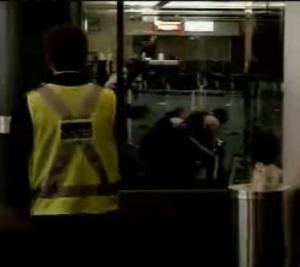
While Paul Pritchard recorded his famous video, Mr. Dziekanski paced angrily back and forth. He threw a TV tray, and then a computer, across the room. Security officers nearby argued amongst themselves about what to do with him, considering that another 300 people were due through shortly.

Their words on the video show that they had no idea where he was from or what language he spoke. At one point, a lady asked him if he spoke Russian. (“Russian? Rossia?”) He shook his head. Later, a security guard is heard saying that Mr. Dziekanski “only speaks Russian” and they should bring in a Russian interpreter “to calm him down.” When the now-famous four RCMP officers arrived, the guard repeated that “he only speaks Russian.”
Police restrain Robert Dziekanski
Thirty seconds later, when Mr. Dziekanski raised a stapler over his head, the Mounties tasered Mr. Dziekanski at least four times, stopping his heart. Although airport paramedics were nearby, they called the municipal paramedics, who arrived and administered CPR about 15 minutes later. Robert Dziekanski was pronounced dead on the scene.

His last words, in Polish, were only understood after the witness’s video was translated: “Have you lost your minds? Why?”

On Friday, the Braidwood Inquiry (the latest in a series of reports) was released to the public. Although it cast some criticism on the airport staff, the report (and the public’s rage) has focused on the “shameful conduct by a few officers.” (This article is not about the details of that conduct. There are plenty of online news stories that can fill you in if you haven’t heard too much already.)

I had avoided the video since it became public in November 2007, because the mere mention of the subject made me feel angry. My angry thoughts were directed at the police, who had killed an unarmed, innocent man.

Not until I finally watched the video on Friday, and read more details online, did I understand more, from a human perspective, about what brought this Polish immigrant to his death.

In those ten lonely hours, after a long trans-atlantic flight, the confusion of customs, and the confusion of his mother’s whereabouts, no human being was able to help Robert Dziekanski. He was exhausted, alone, confused, hungry and probably dehydrated as well. (The autopsy could only report that there were no drugs or alcohol in his system – not whether he’d had any food or water in the last 12 hours.)

The airport staff were more concerned about the other 300 people coming through than they were about this one lost man. It seems to me that they saw him as a potential threat, and not a man in need. They were confused as well. They did not know how to communicate with him, where he came from, or where he needed to go. Their operating parameters involved controlling and restricting people, not reaching out with a gentle hand of compassion.

Before watching the video, I had lots of strong opinions about the police. After watching, my heart filled with grief for this lost and confused man in a strange country, where no one could care for his most basic needs, and his only relative was not allowed to meet him. Robert Dziekanski died alone, because we didn’t know how to deal with him.

This goes way beyond one incident at an airport. It is a telling sign for our times. In this short, tragic video, I see that we, as a people, have lost our ability to help strangers. People are expected to take care of themselves. If I see someone stalled on the roadside, I assume that he’s already called for help on his cell phone. After all, everyone has a cell phone, and everyone has access to emergency services.

If there is a fire, someone has probably already called the fire department. If there is a brawl, someone has called the police. If there is a man wandering around an airport terminal, then surely someone else has it under control.

I don’t need to do anything. They don’t want my help. The ambulance will be here any minute. And the list of excuses goes on: excuses for why I do not need to help my neighbor. Excuses, because I don’t know how to help my neighbor. Excuses, because sometimes it’s dangerous to get involved.

What would have happened if the staff at YVR had been trained in human compassion? What if they had taken an active interest in helping him get where he needed to go? What if they had told his mother what was going on, and helped them get united after the wait was over? What if they had used their hearts rather than their bureaucratic brains?

Law enforcement officers, including airport staff, are trained to deal with threats to public safety. They are trained in fear, not love. They are trained to stop the bad guy, not help the good guy.

This time, Robert Dziekanski was the “bad guy.” Except he wasn’t bad. He was just a guy. And after they stopped him, they didn’t know what to do with him.

The Braidwood Inquiry cited “the shameful conduct of a few officers.” As a legal Inquiry, it has no business talking about the cultural and societal issues behind this death. It says that the airport staff could have done more to help an immigrant who does not speak English. It cannot say anything about our need, as human beings, to treat each other with compassion and kindness, and not fear.

A Course In Miracles was written about 30 years ago, and probably has just as much to say about Robert Dziekanski’s death as the Braidwood Inquiry does. It talks about our collective insanity as a human race. Here we are, children of God, and we cannot see ourselves for who we really are. If we could, we would treat each other with respect and compassion. But we have lost our divine memory, so instead, we focus on guilt, fear and attack. We kill innocent people, because we don’t know what else to do with them.

Robert Dziekanski’s last words echo far beyond the customs hall at YVR. They were directed at four Canadian police officers, but they cry out to every human being on the face of this planet, our hearts filled with fear, our hands covered in the blood of our brothers and sisters.

Have you lost your minds? Why?

(Thanks to Yahoo News, the Canadian Press and Wikipedia for details.)

Posted in compassion, politics | 6 Comments

Being a Hypocrite

I hate hypocrisy. Whether it’s Al Gore driving a gas-guzzling motorcade everywhere, or President Obama extending Bush’s policies, I just can’t stand it when people – especially national leaders – openly refuse to practice what they preach. Sure, we’ve come to expect this from politicians. But that doesn’t make it right.

As I sat fuming about this today, my Higher Self tapped me on the shoulder and reminded me of a spiritual truth: Us humans tend to preach most passionately against what we ourselves suffer from. It’s called the Law of Mirrors: When I cannot see a character flaw in myself (and denial is far more common than we’re willing to admit!), then I am presented with “mirrors” in my life who display that very same character flaw.

When something is too close to me, I can’t see it – like holding up a newspaper to my nose. But when it’s outside myself, in another person, I can see it more clearly. That makes them a mirror for me, to see the behavior more objectively and decide how I feel about it.

If I don’t like what I see, then I’m probably going to judge it harshly. And that opens the door for hypocrisy.

Let’s take a case study from a popular movie, so as not to single out any real people. AMERICAN BEAUTY came out 10 years ago, so forgive the spoiler.

Col. Frank Fitts, USMC (Chris Cooper), absolutely hates homosexuals. He suspects his son of having a gay affair with the neighbor, Lester Burnham (Kevin Spacey), and expresses his rage accordingly. Only minutes after nearly killing his son, he goes over to the Burnhams’ and tries to kiss (not kill) Lester. The truth comes out: He hates gays because he hates himself. He hates his own nature, and when he sees it in other people, he wants to punish them for it, just as he wants to punish himself.

Now, comparing this hypocrisy to the hypocrisy shown by public leaders is a stretch, granted. They are different varieties of hypocrisy. But it does explain why hypocrisy is so darned popular – because we all judge in others what we ourselves suffer from. We are hypocrites because we are not yet enlightened enough (or objective enough) to see ourselves clearly.

We’re too close.

My own habits are like that newspaper held up to my nose. I can’t even read the headlines – even if they are obvious to everyone around me.

Ultimately, the goal of seeing ourselves (and others) more clearly is not to provide ammunition for judgement, but rather to help us practice humility and forgiveness. It is to see people from the eyes of the heart, understanding with compassion, soulfully.

So, next time you see hypocrisy in someone else, you can be grateful for their role in helping you see truth. It is one more step on the road to accountability, enlightenment, and the end of judgement.

Posted in accountability, consciousness, politics | 2 Comments